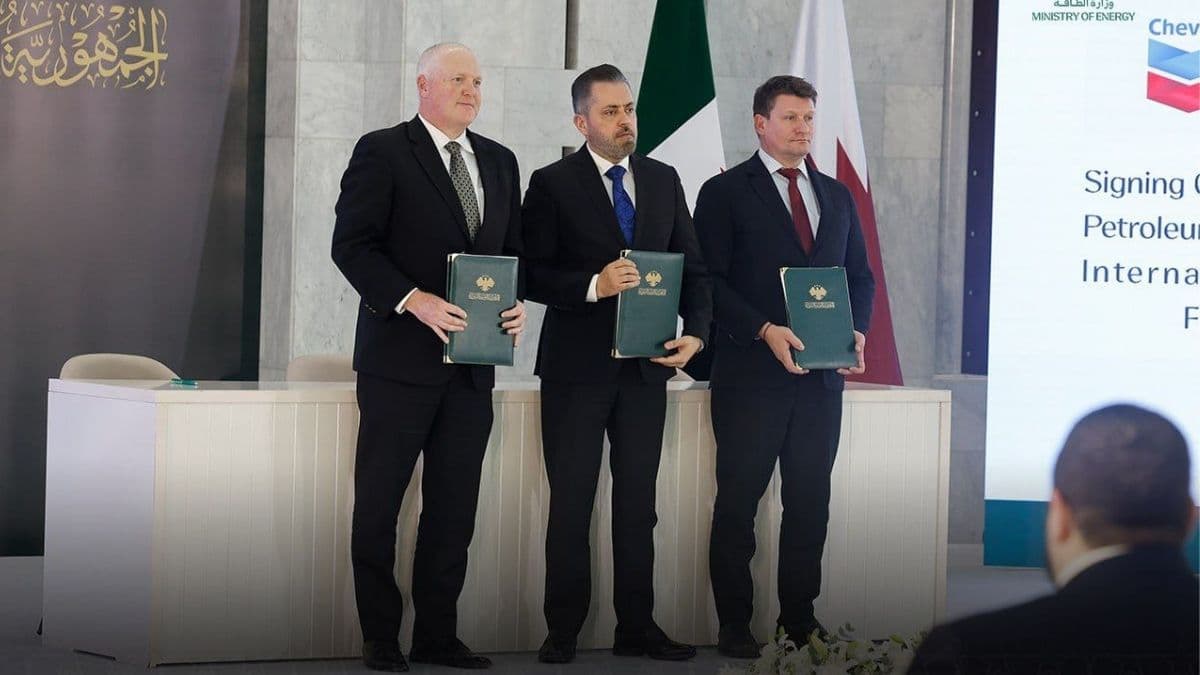
Chevron confirms advance toward Syria’s first offshore exploration
Syrian Petroleum Company (SPC) CEO Youssef Qablawi announced on April 10 that Chevron has given official confirmation to proceed with investment and exploration in Syria’s first offshore fiel...
Syrian Petroleum Company (SPC) CEO Youssef Qablawi announced on April 10 that Chevron has given official confirmation to proceed with investment and exploration in Syria’s first offshore field. SPC says, in cooperation with Chevron and UCC (and following a February 4 memorandum of understanding with Chevron and Qatar’s Power International), the targeted offshore site has been identified, final contracts are to be completed, and technical operations could begin in summer 2026. Enab Baladi asked SPC about the size of Chevron’s investment, the project’s impact on the local energy sector, the expected timeframe for results, and the government’s role in oversight, but had not received a response by publication time. The Syrian Ministry of Energy described the memorandum as opening new horizons for offshore prospecting and strengthening energy security.
Expert assessment and risks
Dr. Mahmoud Abdul Karim, an academic specializing in financial markets and energy, cautions that the MoU signals the start of assessment and seismic surveys—not production. He outlined the sequential, costly stages required: marine seismic surveys (often over $200,000 per day), exploratory drilling (6–10 months), results assessment (6–12 months), appraisal drilling (2–3 years), and installation of deepwater production facilities that can push total development costs above $1 billion. Global success rates for exploratory wells average 20–30%, and examples such as Egypt’s Zohr field show a multi‑year, multi‑billion‑dollar path from discovery to full production. Abdul Karim estimates that meaningful cash flows from Syria’s offshore project are unlikely before 2032 in a best‑case scenario and could slip to 2035 if technical or political setbacks occur. He also flagged structural obstacles—no prior Syrian offshore experience or infrastructure, an incomplete legislative framework for concessions, and only recent lifting of sanctions in mid‑2025—while noting potential economic benefits from preliminary investment (Chevron’s projected early spending of about $2 billion could produce local multiplier effects) and from eventual production if commercial reserves are found. Key indicators to monitor are the shift from MoU to a binding concession within 18 months, establishment of clear offshore investment laws and fiscal terms, the move from surveys to exploratory drilling on schedule, and operational metrics such as drilling success rates and extraction costs, all of which will determine the project’s viability and macroeconomic impact. as reported by Enab Baladi