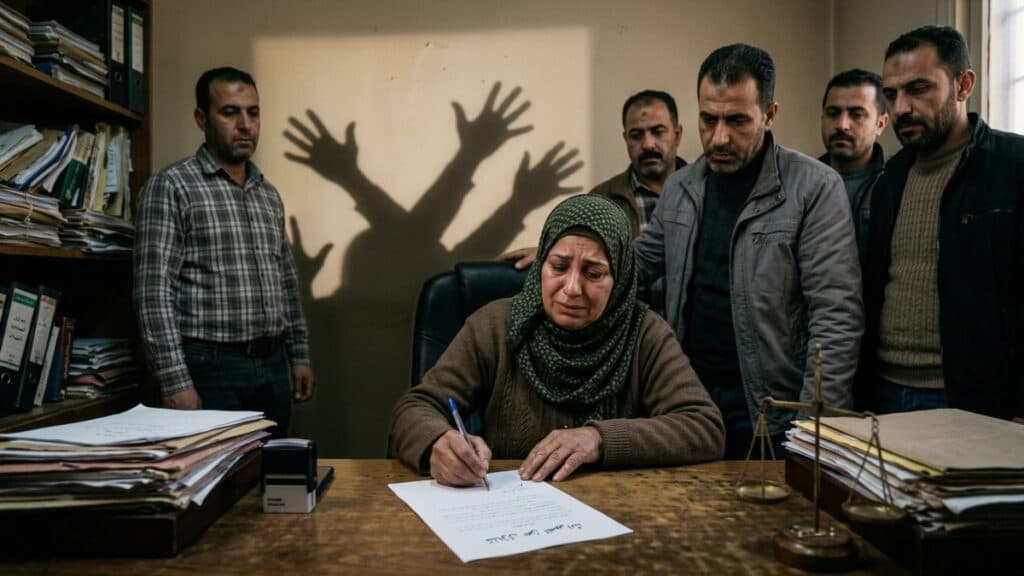
Customs and family pressure deny Syrian women their legal inheritance
Despite clear provisions in Syrian law and Islamic inheritance rules guaranteeing women a share of family estates, entrenched customs and family pressure continue to deprive many women of thei...
Despite clear provisions in Syrian law and Islamic inheritance rules guaranteeing women a share of family estates, entrenched customs and family pressure continue to deprive many women of their legal rights. Enab Baladi documents multiple cases in which daughters and sisters were coaxed or tricked into waiving their inheritance: “Nahla Nasser” signed what she believed was a power of attorney that turned out to be a full waiver; “N. A.” accepted her brother’s verbal promises in exchange for relinquishing her claim, only to be abandoned and later forced to seek help from local notables; and “Z. A.” was persuaded at a post-funeral gathering to give up her claim and ultimately had to go to court to recover only a fraction of her share. These testimonies illustrate a wide gap between the legal text and everyday practice, where social and emotional pressures lead many women to sacrifice rights to preserve family ties or avoid stigma.
Analysis and recommendations
Researchers and lawyers cited in the article point to social norms, misreadings of male guardianship, weak judicial procedures in Sharia courts, limited access to justice in rural areas, and the lack of deterrent penalties as drivers of the problem. Lawyer Ammar Nasser stresses that Syrian law (Personal Status Law No. 59 of 1953) protects women’s inheritance and requires judges to verify that any waiver is given freely, while researcher Ghadran Najm calls for legal-awareness campaigns, specialized and low-cost court services, economic protection units for women, and renewed religious discourse to correct misconceptions. The article concludes that strengthening implementation, removing practical barriers to litigation, and raising public awareness are essential to closing the gap between law and practice for women’s inheritance rights, as reported by Enab Baladi